Where to begin after Army’s fourth-quarter meltdown in a 26-25 loss to Tulsa on Senior Day.
Start with one of my posts, “Win by analytics, lose by analytics.”
Sure, Army’s 4th-and-3 from Tulsa’s 39 is a “go” in book of analytics with a 2-point lead and 1:40 remaining. But, considering how things were going offensively in the second half, punting should have been more considered. Felt like Army was running into a brick wall in the second half, where three yards were hard to come by. Army gained two yards or less on 13 of its 25 second-half carries, including the pivotal fourth-down failure.
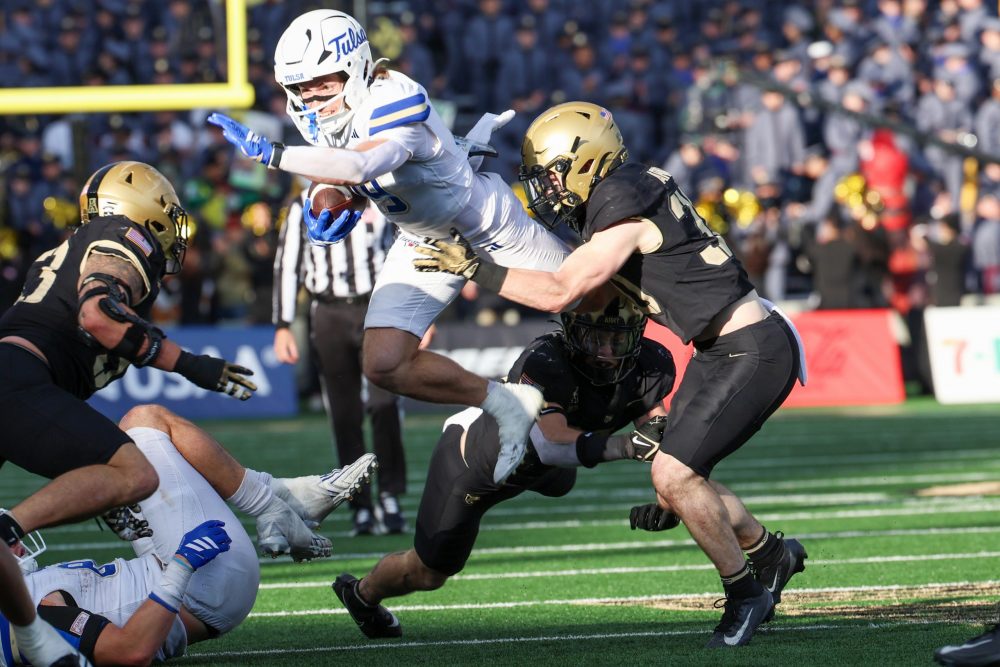
The fourth down in question was a slow-developing QB run by Hellums. Both, the right guard and right tackle pulled to the left. Cornerback Elijah Green held up the tackle’s block causing Hellums to get tripped up, one yard shy of moving the chains and clinching Army’s bowl eligibility. Can’t deny the effort by Green. Heck of a play.
In the postgame press conference, coach Jeff Monken said he was hoping that Hellums would have ran the ball more outside. Hellums sensed there was a better chance of picking up the first down inside the tackle.
CBS Sports Network game analyst Adam Breneman offered an option on late 4th-and-3 play during the broadcast. Try drawing Tulsa offside. If they don’t jump, take the 5-yard delay of game penalty and punt. Don’t think Army considered that as the ball was snapped with 19 seconds left on the play clock.
Complicating matters was Army’s second-down call and its result during the drive. Noah Short ran outside and was forced out of bounds, saving Tulsa from using a timeout. Tulsa did a great job of stringing out the run but why was Army running a run anywhere near the sideline? Running an inside play or staying inbounds would have forced Tulsa to take its final timeout and taken a good 35-40 seconds off the clock before the fourth-down play.
Analytics struck again in the first half when Army passed on a 43-yard field goal attempt on 4th-and-3 from Tulsa, electing to go for it. Short was dropped for a loss on an end around.
“To extend the drive, you take time away from them if you get the first down and you give yourself a chance to get seven points instead of three,” Monken said after the game. “That’s the way we play. Just not going to settle for a kick just because you are going to get points.
“The analytics and our trust in those and belief in those has won us a lot of football games here. It’s won us a lot of close football games. If we execute one of those (fourth downs) or convert one of those, maybe it’s a different outcome.”
Army prides itself on being the tougher team late in games and winning the fourth quarter. Didn’t happen as Tulsa outgained Army 154-40 in the final 15 minutes. Tulsa looked and played like the team with more energy.
Players aren’t being put in the right position to win or players are not executing when they are put in the right position.
Why throw the ball on second down from your own 13 with an 8-point lead in the fourth quarter? Army’s running game was grounded and the Black Knights’ offense was looking for a spark. Brady Anderson drew double coverage, leaving Noah Short and Parker Poloskey available on shorter routes on 2nd-and-8. Hellums forced the pass to Anderson and was picked off for his first turnover in 348 plays (per CBS).
The Black Knights had little to no success on first down after halftime, gaining only 21 yards on 12 plays. Army’s longest second-half play was 12-yard out to Brady Anderson from Hellums, would like to more of that.
Can’t underestimate the effect of the overturning Hellums’ touchdown pass to Brady Anderson had. Offensive coordinator Cody Worley said he sensed playing “flinching” after Army settled for a field goal on its opening drive of the second half.
Army was credited with 10 quarterback pressures but only one sack. Tulsa QB Baylor Hayes was able to extend plays throughout the game. Chased out of the pocket, Hayes completed a 50-yard pass to Donnell Gee along the Army sideline on the game’s first play. A sign of things to come.
Thought Army was going to open up the offense when it came up passing on its first play. Noah Short hauled in a season-best 44-yard reception on a beautiful on-the-money ball from Hellums, who scored from 31 yards out on the next play.
Army chose to slow down the offense pretty much after that against a Tulsa defense, which allowed 39.5 points in six previous conference games. Thought Army might need at least 30 points to win this game. Turns out it needed 27 but still couldn’t get there.
Cale Hellums and Noah Short both reached milestones in the game, becoming the 66th and 67th Army players to rush for more than 1,000 career yards. Hellums, who has 1,016 yards, is 12 yards shy of 1,000 for the season. Short has 1,002 rushing yards. The senior needs 157 receiving yards to be the first player in Army history to have 1,000 rushing yards and 1,000 receiving yards.
Army finished with its first losing record (2-3) at home since 2015 (1-5).
You hit everything. Generally, poor preparation for the expected opposing team defensive strategy and poor play calling. In my opinion, need a different pass defense strategy.






Norm Remick
November 26, 2025 at 7:38 AM
You hit everything. Generally, poor preparation for the expected opposing team defensive strategy and poor play calling. In my opinion, need a different pass defense strategy.